| Yamaha NS-1000M Upgraded (2021) I've
had a few classic speakers now, including Tannoy Cheviots,
Celestion 66 Monitors and the Yamaha NS-1000M. They were all good in
their day and have some good attributes. But compared
to modern designs, they are ultimately flawed in one way or another and no
amount of tweaking can disguise this. I reached this conclusion after
hearing many examples of each, either in stock, renovated, or highly
modified form.
As much as I love the sound of the Yamaha NS-1000M speakers, I don't see them through rose tinted spectacles and I'm well aware of their short comings. Namely, a bass that rolls off quickly, producing little below 50Hz, a forward top end that can jar with bright equipment and/or hot recordings, requiring careful amplifier matching and a mid range short of a little body/warmth. The NS-1000M is all about the superb beryllium dome mid range driver, which images so well. The use of a large bass driver, in a well made sealed cabinet, gives a tight and dynamic sound, if lacking somewhat in real depth. The dispersion characteristics of the complete driver system are excellent, so it's not all bad and they deservedly have a good reputation. Like many owners, I feel the performance is very good, but it doesn't quite succeed, in terms of matching my expectations of what the ultimate set of loudspeakers should be. We always want more! With this in mind, I've been trying to improve on the original, adding greater depth to the bass for starters. Several people have gone the ported cabinet route, when trying to achieve deeper bass, but I didn't want to do that and I don't like separate Sub Woofers. Instead, using the Yamaha Mid Range and Tweeter, plus a modern Scanspeak Woofer, I hoped to achieve better bass response, while keeping to the original sealed box concept. If you are concerned about originality, stop reading now. The only things that will remain from the original NS-1000m are the Mid and Twt drivers, everything else will change. It's a bit unfair to say this project is an upgrade, it's really a new 3-Way design using the Yamaha Mid/Twt and a modern take on the original theme. The project has been through many, many variants over the years and this is the final version, which naturally gives the best performance I achieved. It has a flatter response than the originals and good quality bass down to around 20Hz. It's also fair to say, that this project can't be judged, purely as a pair of loudspeakers, the active/passive crossover circuitry, plus the carefully chosen and tweaked Amplifiers, are integral to the overall performance.  The Scanspeak 30W/4558T00 12" driver pictured above, was used in another project of mine. It works well in an ideal 55L closed volume, which is only fractionally larger than the Yamaha's 50L. But it goes significantly deeper, achieving an f3 of about 33Hz, measured in my room. It's an easy choice and is in keeping with the original Yamaha sealed box concept. It's actually a Sub Woofer driver, used in some award winning products. It's response curve doesn't look like the usual Sub drivers single hump profile though and is remarkably flat, extending well up the frequency range. Because of this extended range, many dealers list it as a Woofer. With its Sub Bass heritage, it readily accepts a Linkwitz Transform circuit to boost the low bass output. Using this circuit, the bass can be extended down to an f3 of 20Hz or lower. The drivers low fs, high power handling and huge XMax mean it is easily capable, yet it also produces good quality bass. There is no smearing of leading/trailing edges and it integrates well with the Yamaha midrange at the original crossover frequency. 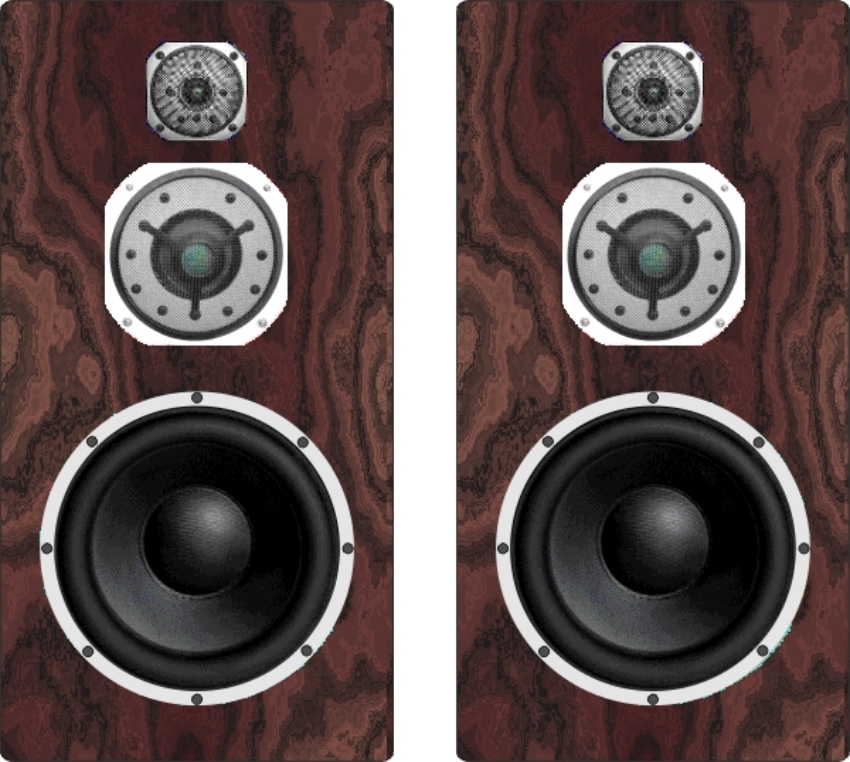
This is what the drivers should look like in an ideal 55L sealed enclosure.
I've kept the original spacing of the Mid/Twt, but centered on the baffle, as in the NS2000. |
 |
 |