February 2025 I pulled the deck out of storage, I had lost interest in it due to drifting values and frustration with the wire dressing. I had one last attempt at sorting out this combination of Direct Drive Turntable and Linear Tracking Arm. 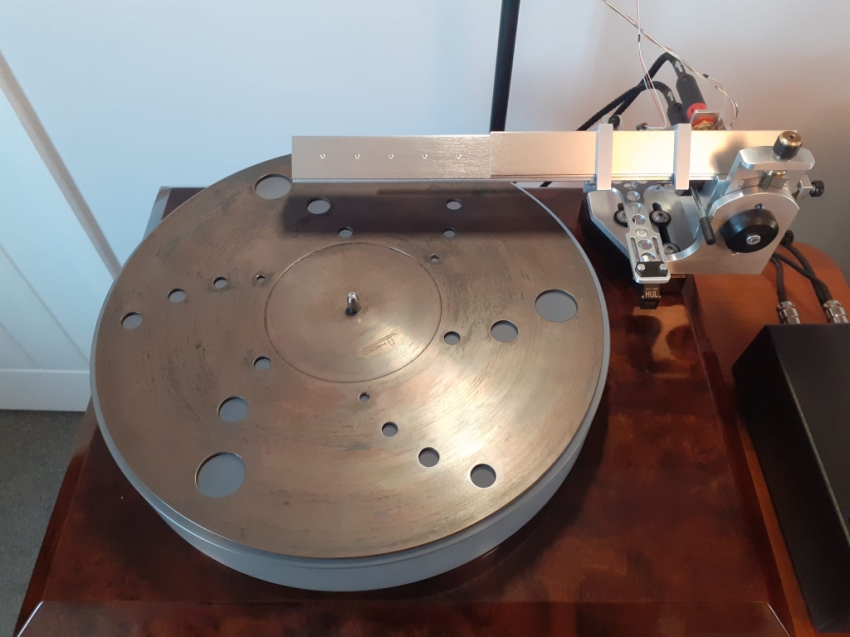 Here it is with the fully fettled arm fitted, an SPH Copper mat in place and my Van Den Hul MC One Special cartridge mounted. Most of the issues I had with the Arm were caused by the flexing of the Mounting Plate, which I cured by re-designing it and making a new one. The arm wire type and dressing method was also resolved. Making the Arm much more reliable and consistent.  I fitted a spirit bubble to the Arm Wand to help with VTA and Azimuth settings. I mounted the Van Den Hul cartridge as far forward as possible, to reduce the effect of different record thickness on VTA. I removed the Isonoe feet from the deck as there was to much bounce and replaced them with flat swiveling furniture feet.  The DIY external Power Supply continues to give good service, its controls and badge being the only hint, that the deck is based on a Technics SL-1200 Direct Drive motor and control circuit. Finally, I got the arm/deck combination working as it should. Performance I
compared this Technics/Terminator deck, with my stelwart heavily
modified Lenco GL75 based Idler drive, with original Mission 774 Arm.
This is a great combination and gets lots of attention and praise when
I take it to HiFi meetings and shows. The
Lenco/Mission set up is good, but the Terminator set up is slightly
better, period! I tried running the Acrylic platter bare, as recommended by the manufacturer and then with the 3mm Copper mat, optimizing VTA for each. I preferred the Copper mat. With the bare Acrylic it initially sounds impressive, more dynamic, but after a while I realized it was just a little to euphoric and there was a tiny amount of break up at the top with female vocals. Lowering the VTA cured this distortion, but then sounded a bit rolled off. The Copper mat sounds more even across the whole frequency range and I can listen with more confidence and at ease, but its still not ideal, sounding just a touch flat with a narrow sound stage. I noticed the Copper mat was a smaller diameter than the thick Acrylic Platter and a record overhangs its edge by about 5mm. The 300mm platter is the same size as a record. A record has a thick bead on its edge, this helps during manufacture and also helps guide the stylus into the start grooves. I put a straight edge on one half of a record and you can see quite a gap under it, as it rests on this thick edge. It stands to reason, that when on the bare platter, the record will be resting on this bead, with a gap under it. A tap of the finger on the record confirmed it was not resting on the platter and was suspended in mid air from this thick edge. I bought a 3mm Acrylic mat the same diameter as the Copper one and tried that. It might seem strange, putting an Acrylic mat on an Acrylic platter, but this allows the records edge bead to overhang and the record surface to sit flat. Many of the mat suppliers, make a big thing about having a recess for the label, but its pointless in my opinion if the record sits on its thick edge.
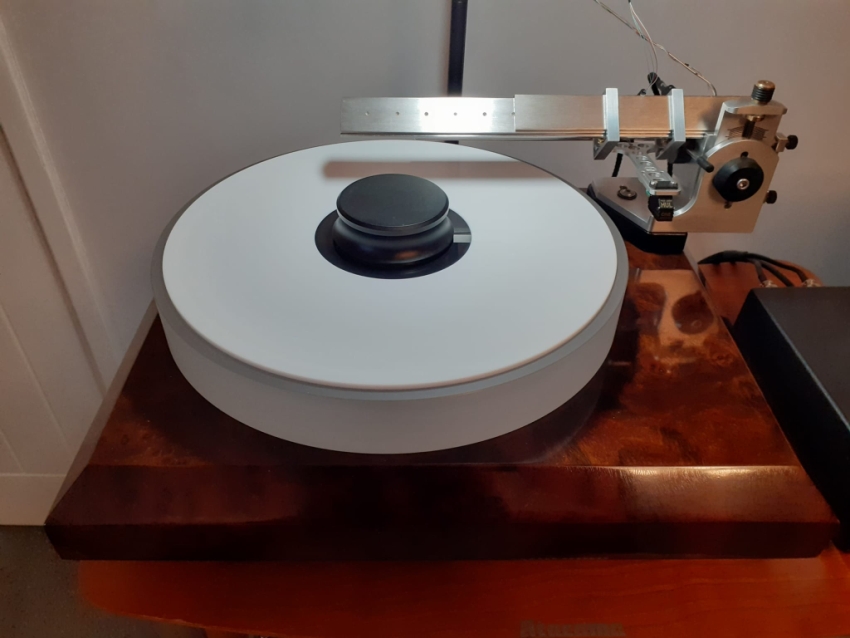
This is what the Acrylic mat looks like on the Platter and it works like magic, not as euphoric as when running the record on the bare Platter, suspended by its outer edge. Not as shut in and restrained as the Copper mat, which seems to over damp things slightly. It has the best traits of both, without any of the draw backs. A record sits flat on the smaller Acrylic mat and gives a wide sound stage, open and dimensional presentation, with great transparency, detail and dynamics.
After reading many reports from Terminator users, about the mat produced by TransFi Audio, the Resomat, I decided to give it a go.
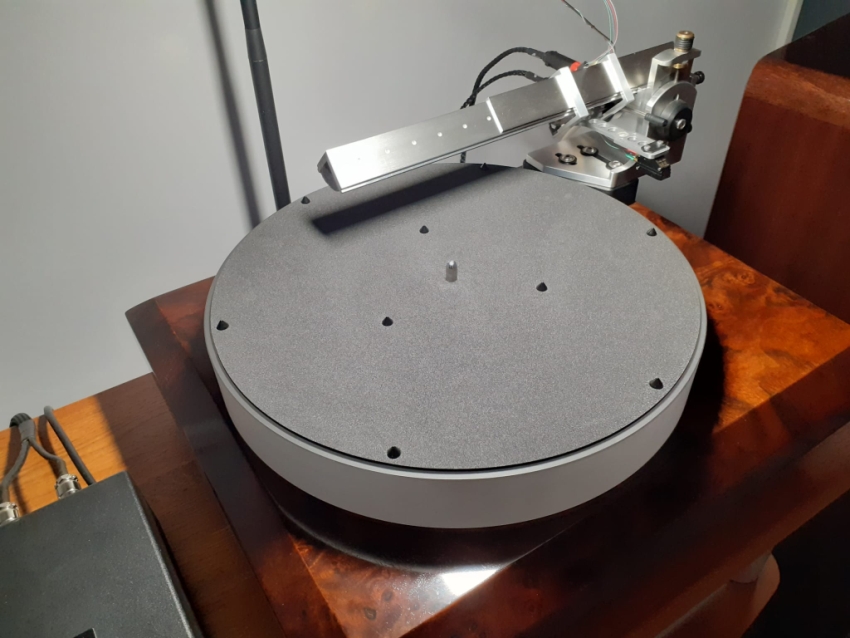
This mat is made of neoprene rubber, with 9 equally spaced cones fixed to it. I initially used the VDH MC One Special cartridge on my Lenco/Mission
deck and a lowly AT33PTG II on the Technics/Terminator, I preferred the
Terminator deck. I swapped the VDH in to the Terminator and this only
confirmed the Terminator is the better sounding set up. |
For more information on the "Terminator" Linear tracking Tonearm, check out its project Here: |
 |
 |